1-handed Recorder for a Beginner?

I was recently asked if I could suggest an instrument to enable a 1-handed child to join a beginner recorder class and thought my reply might be helpful to others:

Lovely to hear about your young would-be recorder player! The good news is that there are 1-handed recorders available and, depending on the child’s disability, may not be strictly necessary but there’s quite a bit of bad news too!

A 1-handed recorder makes all the notes available by adding keywork that can be raised and lowered using just the fingers of the available hand. This means that, once the notes played with just one hand have been mastered, the player must use a totally different system of fingering (ands this varies from one manufacturer to another). The teacher taking a class of players using normal fingering would not know this system and would have to familiarise themself with it without the benefit of having learned the new instrument. Of course, this would be eased by the class only needing to learn one new note at a time. The more complex system of fingering is also challenging for the child and may be beyond her if she has learning difficulties. A child with cerebral palsy is likely to have poor finger control and coordination, adding to the problems.

Although, I have taught a player on two different systems of 1-handed plastic recorder, I am unable to track down either of them at the moment. One was manufactured by Yamaha but there is nothing about 1-handed models on either their global or USA sites. You’d have to contact them directly to enquire. I believe Aulos also do one but, again, I can’t locate a supplier. Quality wooden instruments are available but expensive (over 600 US Dollars) and I wouldn’t recommend such an investment at this stage. There is an Aulos instrument in six sections (as opposed to the customary three) that can be customised to the needs of a player who has 6 digits available between the two hands. This is available from an American source at  http://www.rhythmband.com

Again, the cooperation of the teacher would be required to set it up.

If the child can use all the fingers and thumb on one hand, the first five notes can be played on a standard recorder and I would suggest getting one of these, very modestly-priced instruments to see how she gets on. Simple music for this stage is available in pdf format from the Full Pitcher at

http://www.fullpitcher.co.uk/easyrecordersco.htm

These start with reminders of the written notes, warm-ups and tunes for just the first two note. Using these she could get in the extra practice and home support, likely to be needed by a child with special needs.

Do let me know how you get on and get back to me if you have further queries.


Posted in Class Teaching, Instrumental Teaching, Special Needs | Leave a comment

New Year, New Beginners – New Music?

Not a few people will be the delighted recipients of new musical instruments as Christmas presents. For beginners, it’s the start of a great new journey and they can’t wait to set off and it’s a joy and privilege for teachers to set them on their way! The first few weeks are not without anxieties for teachers, though, as the pupils discover that there is very little instant gratification in playing a musical instrument. While the pupil can play only 2 or 3 notes, the only available tunes are likely to be in the chosen method book. This is fine for the pupil who can sail quickly through the early lessons but it can be a problem when reinforcement is not only desirable but necessary before proceeding to the next step. This is where the Full Pitcher beginner downloads can come in very useful. The “…. Start Here” series is available for Recorder, Flute, Clarinet, Violin and Cello. Each download has warm-up exercises and several tunes, the first using just 2 notes. They are in pdf format and can be displayed on screen for class use or as many copies printed as are required. Piano accompaniments are also available. Unlike many beginner pieces, though, these do not have the main interest confined to the teacher’s part! The scores can be listened to online and, in some cases, there is also audio of accompaniments only, “minus-one” style.

Have a great journey!

Posted in Class Teaching, Instrumental Teaching | Tagged | Leave a comment

Singing Rounds in the Classroom

Singing rounds is a simple, accessible activity which provides opportunities for a wealth of musical learning and development. It is an easy introduction to the highly satisfying experience of singing in harmony. The only thing that holds back some teachers and their classes is the lack of strong leaders to aid beginners in holding their part. Since the advent of music technology with multitrack recording , though, backing tracks are available with each voice part played by a separate instrument, or group of instruments, so providing strong support for each part.

Singing in parts isn’t the only way to make use of rounds in class, though. Rounds, by their very nature, are built on very few  chords and, often, only a single chord. This means they can effectively be accompanied by short repeated phrases on a voice or instrument. Quite young children will soon learn to sing the melody over one of these repeated patterns, technically termed an ostinato (‘obstinate’) pattern. As they progress, pupils may be able to manage two, or more, of these accompaniment patterns. This is an easier experience of singing in harmony than singing the entire melody in parts. Special needs pupils, unable to learn the whole melody, may be able to sing, or play, a short ostinato.

Rounds also afford many opportunities for creative involvement including:

  • choosing an instrumental sound for an ostinato which will enhance the mood of the song
  • rearranging the sequence of phrases to create a new piece
  • improvising an ostinato, or even a whole new melody, on the notes of the chord
  • varying the sequence in which instrumental parts enter to create new orchestrations
  • composing an introduction section before the main melody enters.

Some years ago, when Becta’s Teachers Resouce Exchange was in operation, I uploaded two resources based on “A Bell Round”. This is the same tune used in “A Christmas Round” but with different lyrics. Level 1 was intended for use at Key Stage 1 and Level 2 at Key Stage 2. The resources comprised sheet music PDFs and MIDI files, describing a range of activities Now that, sad to say,  TRE is no more, I have adapted the resources to this site and they can be found at http://www.fullpitcher.co.uk/COL_ks1.htm and http://www.fullpitcher.co.uk/COL_ks2.htm. Music and lyrics  for “A Christmas Round”, and several others, can be downloaded at http://www.fullpitcher.co.uk/PDFMusic.htm.


Posted in Class Teaching, Improvisation | Leave a comment

Creating Recital Pieces for Flute Beginners

When preparing concert music for an absolute beginner, there are a number of tricky points to take into consideration. Having created, what I hope will be, attractive melodies using a very restricted range of notes, I must remember that a flute beginner may be unable to make any appreciable variation in dynamics. Indeed, the teacher may not wish to introduce dynamics in the early stages of tone development. Teachers also introduce articulation at different points. If music is stripped of its expression, however, it loses much of its ability to engage both performer and audience. In the ‘Stars From the Start’ concert music for beginner flute downloads, I have included two versions of the solo part, one with and one without markings. I hope this will make them useful resources for teachers in several ways. The unmarked copy allows the teacher to add dynamics and/or articulation as appropriate for an individual pupil. The pdf files can be printed as required and can be used for aural training, with the teacher playing his/her version and the pupil identifying the dynamics. Unmarked scores also afford pupils the opportunity to improvise their own version.

Most pieces in tutor books, at this stage, are too short to make satisfying concert items, yet it is too challenging to both the skills of the pupil and the time available in a lesson to cover much material. With this in mind, I have made much use of repetition in these tunes to make them a more rewarding length, without adding to the burden.

See: beginner flute concert pieces


Posted in Instrumental Teaching | Tagged , , , | Leave a comment

Sight-reading and notation

Many of the world’s finest musicians do not read music, so perhaps  we teachers worry too much about notation! Pupils have different learning styles with some depending more on aural ability, while others are ‘visual’ learners who are unhappy unless they have ‘the dots’ in front of them. Occasionally, we may encounter a pupil who is downright resistant to reading from the score and I have one of those at the moment – very frustrating! Nevertheless, the player who cannot sight-read is generally at a great disadvantage: opportunities for independent exploration of new music and playing in ensembles are far more limited for the non-reader. So, while I’m unfazed by the pupil who wants to take a predominently aural approach, I want to do all I can to foster reading skills.

Most of my pupils are exploring new pieces all the time, as they learn lots of quick-study pieces and I insist on covering a broad repertoire at each grade. We adopt a creative approach, with most using the commonly-encountered rhythmic and melodic patterns in
improvisational activities. The familiarity of these patterns to mind and fingers is key to elementary sight-reading.

Fluent sight-readers are looking ahead and recognising familiar patterns coming up. Each bar or so is rapidly memorised and executed by the fingers, while the eyes scan the next. Page-turners are often amazed at how far ahead the performer wants the page turned! We can practise this skill in the same way that school-children practise their spellings: Look at a bar of music for a few seconds, then ‘cover’ it and try to reproduce it from memory. Go back to the music and check the ‘spelling’. Repeat the process until accuracy is achieved. We can do this with each or any of the bars of a piece of music that is new to us before attempting the whole. It is good to note down the date and tempo and return at a later date to read it through at a faster speed.

In the field of literacy, the research behind the “Ladybird Keywords Reading Scheme” found that 12 words make up a quarter of all the words we read every day and 100 words account for half those encountered daily. Similarly, a few rhythmic and melodic patterns account for a high proportion of those encountered in music scores. My “Rhythmic Reading Through Improvisation” is designed to familiarise pupils with the patterns used in sight-reading tests at grades 1-3 and to make learning more fun. Part 1 uses just rhythms and mastering these generally has the biggest impact on sight-reading. Part 2 follows the same
sequence with pitched notes. Part 2 has to have a different pitch range for different instruments and I haven’t made that available online, as yet.

Posted in Improvisation, Instrumental Teaching | Tagged , | Leave a comment

Music Resources for Special Needs Groups

I describe myself as a teacher and facilitator but, in reality, all teachers are facilitators: we try to make pupils aware of, and develop confidence in, their abilities: to enable them to do what they can do. Over the years, as a freelance teacher and independent educational consultant, I’ve been asked to adapt my ideas and resources to many special needs situations. I’ve been approached by carers and teachers who believe passionately in the value of music to those in their care but they seldom dream that they, themselves, can provide such musical experiences.

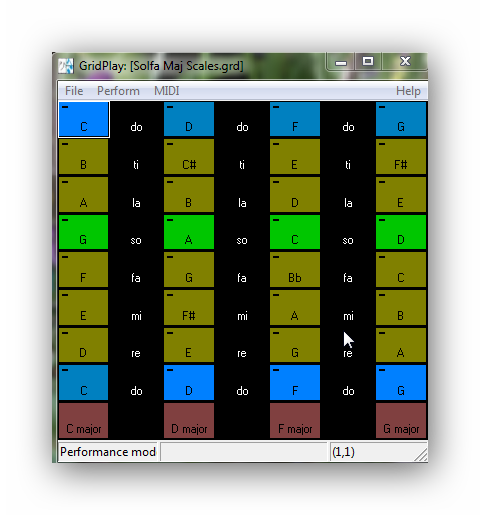
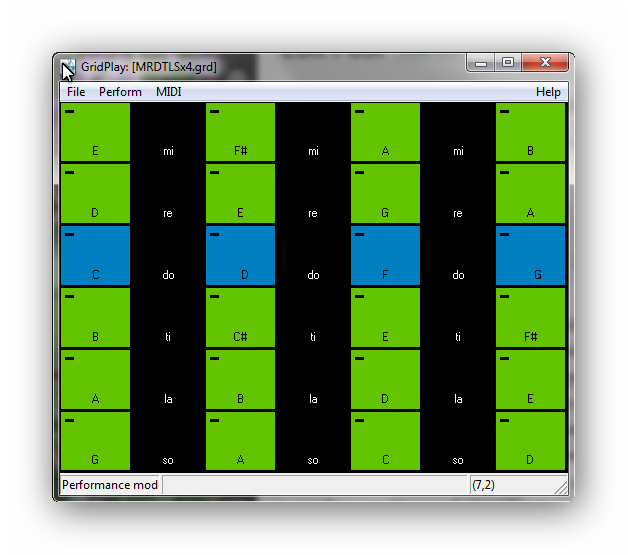
Often working alone, without an accompanist, I turned to technology to fulfil the latter role so that I could engage fully with the participants. Soon, the amazingly versatile ‘MIDIgrid’ software, developed at York University, became an essential resource. This is ‘content-free’ software, something like a word-processing and presentation package for music. I found that, in addition to providing speedy access to customised backing tracks for the sessions, I was able to use the software to create virtual instruments which could be played with a range of special access devices. Having established a computer-based system with resources that had proven their worth in a range of situations, I saw that this was a way in which I might enable carers to run their own sessions. In 2005, York University created GridPlay, the Full Pitcher’s read-only version of the software, which I could distribute with my resource packs.

Mindful that making provision for someone with a disability is a very individual matter, the special needs resources were offered as a customised, created to order, product. This, however, has proved a bit daunting to many who don’t really know where to start. So, our new GridPlay for Carers/Teachers takes a different approach: the package includes the most generally useful resources, with unlimited post-sales support and customisation. Also included is a 43-page e-book, with ideas for using the grids, sheet music for several original songs and suggestions for initiating and sustaining music sessions for people with profound disabilities. Hopefully, this package will enable many more carers and teachers to make music with those in their care. At a time when it is increasingly difficult to find the funds to buy in specialist provision, this will, hopefully, be ‘half a loaf’ for many who would otherwise go without bread. See:  http://www.fullpitcher.co.uk/software.htm

Grids from the GridPlay resource packs can be loaded into the parent program and, in the latter, users can create and save their own customised versions of the grids. In this way, teachers can create grids set up for different methods of access and can also save recordings made by pupils playing the virtual instruments.

Posted in Class Teaching, Special Needs | Leave a comment

Sheet Music for Absolute Beginners

In the first few months of instrumental tuition, teachers and pupils are generally very dependent on whatever method book has been selected for the pupil. These methods usually introduce one new note or rhythmic duration at a time, along with tunes to practise the new introduction. There is a plethora of methods on the market, so it should be possible to find something to suit each individual. However, the material provided at each stage is often insufficient for a pupil to master it. Moving on prematurely to the the next unit can leave the learner confused and losing confidence. Matters may not be helped by the way in which these books often head their units “Lesson 1”, “Lesson 2”, etc., which makes the learner feel they are failing if they are unable to master each in a week or two.

I frequently have pupils invest in two method books so that they have more repertoire at each level. With adult pupils, this allows me to draw their attention to the fact that teachers have different ideas about the way in which new learning should be sequenced: one may introduce note values more quickly, while restricting pitch to very few notes; another will adopt the opposite approach, and so forth.In the same way, pupils may progress in one area quicker than another. I prefer to delay selecting a method for an absolute beginner until I get a bit of a feel for their individual learning style. As a composer, I’m able to produce original materials for my pupils and I greatly enjoy the challenge of composing satisfying music from severely restricted resources. This was the origin of the “…..Start Here” series and “Sheet Music Starters” Many of these pieces are now available as downloads from the “Music for Beginners” section. They are intended to supplement popular method books. When a pupil needs supplementary repetoire for a particular unit, or to revisit an earlier one, it’s great to have access to another source of sheet music!

Posted in Instrumental Teaching | 1 Comment

Easy Ensemble Music in the Classroom

An exciting aspect of music teaching is that of introducing diverse people to a shared heritage that each can enjoy and recreate in their own way! Thus, one of the first resources I wanted to make available when I set up the Full Pitcher website was a collection of arrangements that had enabled me to facilitate music groups made up of players of hugely different musical and technical skills, where the composition of a group was subject to change from week to week. Although the basic arrangements stayed the same, parts were frequently customised to the needs of individuals. The core arrangements I made available as Easy/Classroom Ensembles and Flexible Ensembles. For the website, many easy pieces were standardised to meet the needs of classes at Key stages 2 an 3. In my own sessions, group members, who were able to do so, were given the freedom to elaborate their parts, or I adapted them, and I frequently introduced improvisational activities which allowed everyone to contribute at their own level. Ideas for this kind of creative work with beginners  can be downloaded from the Easy/Classroom Ensembles page.

For the first few years, sheet music downloads were in the format of Sibelius ‘Scorch’ files, which meant that users could preview the written music and could transpose parts to any key before downloading. This had all the flexibility I wanted to offer but proved prohibitively expensive to run!  It also meant peoples had to install special software and many found it confusing. I came to actually dread selling a score, anticipating the support that might be required! In 2006, I moved the site to a new hosting platform, where I could make the playback available in Flash audio, which is compatible with the vast majority of browsers and could sell PDF sheet music downloads. It isn’t currently practicable, or economically sensible, to offer parts in every transposition but, if what you need is not available on-site, the custom-print service will make a custom set of parts available at very reasonable cost. Printed Packs for the classroom ensembles, with multiple copies of parts for C, Bb and Eb instruments can be found at Packs: Easy/Classroom Ensembles

Happily, few teachers will have to cope with the the enormous range of ability and floating populations that characterised my community workshops, but all could surely benefit from having a few really flexible pieces up their sleeve for when things don’t go to plan! :>)

Posted in Class Teaching, Improvisation, Instrumental Teaching, Special Needs | Leave a comment

Special Needs: Starting the Session

Setting the scene is important in any music session and in the classroom or rehearsal  space this usually begins non-verbally with the arrangement of the furniture that greets participants when they enter the ‘music space’.  If the session is taking place in the general living area, there may be limited scope for rearranging the physical setup but it’s vital that the the music leader should be able to get close to each participant and make eye contact. The best arrangement is to seat them in a semi-circle around the leader and/ or accompanist. Anyone who needs a wheelchair tray or small table to support an instrument or switch should have this in position, ready to receive an instrument at the appropriate time.

When sessions take place in the living space, televisions, music-players, etc., should be switched off well before the session. In this ‘quiet time’, attention will be engaged by watching the leader set up for the session. When the moment to begin finally arrives, the air of expectancy may be further enhanced by the leader playing a very quiet and simple tune on melody instrument, whilst endeavouring to make eye contact, or singing a song such as “Something Is Going To Happen”, written by Clive Robbins and Paul Nordoff, expressly for this purpose.

‘Gathering’ songs further secure the engagement and will pay dividends later in the session by focusing attention. This is particularly true of those which elicit both a verbal response and physical activity, such as tapping an instrument, clapping hands or raising arms.

See Living My Song Specials to download  sheet music and listen to two examples. You can also see the lyrics and listen to the music of “Come On, Everybody, It’s Music Time!” by clicking here.

Posted in Class Teaching, Special Needs | 1 Comment

Piano Improvisation for Beginners

Getting started with improvisation can be more daunting for pianists than for players of melody instruments because of the need to combine both melody and accompaniment. Nevertheless, we have uploaded some ideas for improvisation which can be explored by absolute beginners, whilst remaining absorbing and useful activities for more advanced players.

See Improvisation for Beginner Pianists

Enjoy!

Posted in Improvisation, Instrumental Teaching | Tagged , | Leave a comment